Showing posts with label Soviet. Show all posts

Saturday, September 19, 2026

Mesopotamian action 1916

This week Murray and I returned to Great War Spearhead, with a scenario set early 1916 in Mesopotamia. It is not an historical scenario, but rather one inspired by the sort of positional conflict you see in such battles as Sannaiyat, Ramadi, Daur and Tikrit. 

A Turkish division is manning defences in advance of a town, flanked on one side by a river (the Tigris perhaps?) and a dried watercourse or wadi on the other. A British division is attacking with the aim of breaking the defensive line and taking the town. It is supported by a naval flotilla of two gunboats. Their task is complicated by a significant supply problem: a shortage of artillery and shells. One of the many features of these battles was the impact of the mirage, the visual distortions caused by the heat. Accounts talk of this creating a severe limitation on target location generally, and on artillery especially. To simulate this, while the game is 12 turns in length, all location between moves 4 and 10 is limited to 12" regardless of any other circumstances (e.g. hill contours, target firing etc).

The game was fought using my 6mm armies, all of the figures from the Irregular range. The gunboats were scratchbuilt.


Turkish OOB and scenario rules

British OOB and scenario rules

British attack plan, which includes a deep flank march by units of the ANZAC Imperial Camel Corps (yes I know, wrong part of the Middle East for them, but it's still a fictional scenario)


View from behind the British attack. Two Turkish regiments hold the front defences, and one is in reserve in the rear defensive line. Their left flank (right of the photo) is held by a unit of Arab cavalry. The centre British brigade is held in reserve. The wadi is clearly seen on the upper right

The gunboats steam ahead


The  Arab cavalry

The British left flank brigade (the 19th) advances with the gunboat flotilla in support

The British reserve

The British right flank brigade (the 17th) advancing

The ICC deep flank march pushes in behind the Arab cavalry unaware of them at this stage

Turn 3, and the British ICC unit arrives on the Turkish flank after a successful deep flank march

The Turkish commander deploys his divisional cavalry from their reserve position to counter the threat to their flank

The gunboats take fire from a battery of Turkish 76mm guns, and a company of Turkish MMGs

One of the gunboats is suppressed

The early firefight sees significant gaps appear in the British 19th left flank brigade

On the British right similarly the attackers (7th Brigade) are caught in quite a firestorm of fire

The second gunboat remains suppressed while the first, having eliminated a battery of Turkish 76mm artillery, inflicts a suppression on one company of Turkish defenders

However that left flank Brigade (the 19th) is taking severe punishment

The 7th Brigade on the British right coming up against the Turkish defences


British casualties start to appear amongst the 7th too too

The ICC start to win the firefight with the Turkish cavalry even though the Turkish troops have the benefit of occupying the wadi

The ferocity of the firefight with the British left flank 19th Brigade, and the extent of the casualties, are clear to see here.

The British right flank brigade has secured some cover within a central palm grove


The Arab cavalry advance into the wadi.. what is their plan?

The ICC are still held up by the remnants of the Turkish divisional cavalry, which passes it's first morale check


The 19th Brigade is finally beginning to inflict casualties on their opponents in the light entrenchments, especially with the divisional artillery finally getting in to action firing direct from the raised ground tio their rear, but note the huge gaps in their formation. This has cost them dearly.

This is the Turkish right flank facing 19th Brigade

The British reserve brigade has been committed (seen on the right of this photo) and is joining the attack against the Turkish centre, but there too the Turkish defenders are proving resolute, and their fire is proving effective

The British right still heavily engaged

The Arab cavalry have emerged from the wadi, their intent now clear, to threaten the British right flank

The ICC are pushing forward, but it may be too late. The Turkish cavalry have done their job.

At this stage we ran out of time (we really must learn to spend less time yarning over a beer at the start of the evening). The British attack has clearly failed. The Turkish reserve remains uncommitted, and both of the forward Turkish regiments are still a way of first morale tests, while the British attackers have suffered severely. The British gunboat flotilla proved to be less decisive than we thought. As the British commander I might also have been. more thoughtful in the minor tactics of how I brought the  initial attacking brigades into the attack.

However all in all another damned fine outing for the GWSH armies.


Sunday, August 23, 2026

Pushing the boundary out a little

Some years ago I experimented with the idea of 'Cold war gone hot', the idea of an armed conflict between the Soviet Union in the years immediately following the end of World War 2. The only real attraction was to get more use out of the WW2 armies while adding in a little of the more modern vehicles and options, largely for the aesthetics. For that purpose I'd bought a box of the Plastic Soldier Company 1/72nd T55s, to be used as look alikes for the earlier T54. 

While I have plenty of other figures up for painting (a DBA Theban army sits on the painting table undercoated and ready for some attention) I just felt like assembling the T55s. It's rare these days for me to get that old school plastic kitset urge.

The PSC kits are quick assembly, with track units supplied complete, which is something of a relief as I dislike that sort of work. A few years ago I had an operation on one hand, resulting in the surgeon nicking a nerve leaving my right thumb with no feeling down the outside. This can make tasks requiring finer motor skills somewhat more challenging.

Anyway.. here are the three T55 models. The rules will of course be Spearhead, with the combat factors for the T54s suitably imported and adapted from the Modern Spearhead set.


Will they ever see service on the table top? We'll see....

Tuesday, July 14, 2020

A great bit of 'myth busting'

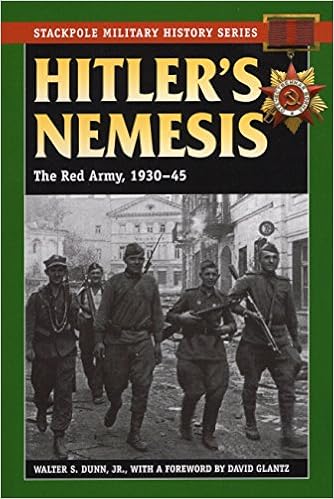
I really enjoy good authorship and research that busts popularly held myths. In that vein some years ago good friend Pete lent me a couple of books by American researcher Walter S Dunn on the Soviet army in world war 2. Over the Covid lockdown I ordered a couple of those books to add to my own library:


Stalin's Keys to Victory: The Rebirth of the Red Army in World War II (Stackpole Military History Series)

Dunn has researched meticulously over the years, using original Soviet sources, and German sources, amongst others. He notes that often the German intelligence view was very close to that confirmed by the Soviet sources.

Dunn presents a mass of data that explodes many of the myths which I have to admit to having previously held. I'll describe one area in particular to make the point.

It os commonly held that by 1944/45 the Soviet Union was running out of manpower. Dunn uses population data to show that in fact the opposite was true. He shows that birth rates post civil war rose significantly, and health outcomes also improved. This meant that the Soviet Union was in fact able to mobilise up to 2 million men each year to add to its armed forces. The final wartime conscription 'classes were the biggest of the entire war.

What's more, the total armed forces deployed on the eastern front were maintained at over 6 million right through 1943 to 1945.  This is not to downplay the huge cost in lives that was the eastern front, but the myth of human wave attacks overcoming the staunch German defence simply do not stack up. This may have been the case in 1941, and possibly at times into 1942, as the Soviet Union worked to re-establish its economy and supply the armed forces with the weapons that they needed. 

Dunn describes the reductions in size of rifle divisions, something that others have held up as proof that recruitment was difficult. In fact, rifle companies were reduced in size and support units are expanded. Armour, artillery, tank destroyer, and self propelled gun, units are an ever greater part of the Soviet forces. The Soviet Union places ever greater numbers of automatic weapons in the hands of fewer troops so that firepower and combat effectiveness are not compromised.

There are many other old myths exposed by Dunn's work. He shows that by 1943 the Soviet Union had effectively won the economic war, the war of production, this coinciding with the Soviet command structures finally maturing to the point where Russian forces were capable of breaking the German line anywhere they chose.

This is good stuff, although Dunn's writing style can be repetitive, and the sheer volume of data is mind boggling at times. I don't normally buy non-fiction books in soft cover, but the hard back editions are a little pricier than I can afford. That said, I am glad I bought these. There are another few Dunn books that I think I'll invest in too.

This is a great bit of myth busting, based on solid reliable data (if the bibliographies are anything to go by). There's nothing better.

Saturday, February 4, 2017

Coming from be-Hind .. nasty beasts

A little pottering resulted in these two Hind Hi 24 helicopters joining the nascent Soviet force. I simply added the green camou to the paint jobs, gave them a brown wash, and added the acetate 'rotors' as the existing blades were broken.


Some very useful helicopter support, having been on the receiving end of two of these a few weeks ago.

Somewhere in Greece 1941

I have long been a fan of Jeff Plowman's military history writing, and have a number of his books on my shelves. Once again just recentl...