Kings of War time again, and this time a largely Human force (Kingdoms of Men), with just a few Dwarf reinforcements, stood before the Orc hordes. The Orcs were keen to get forward and in to contact.
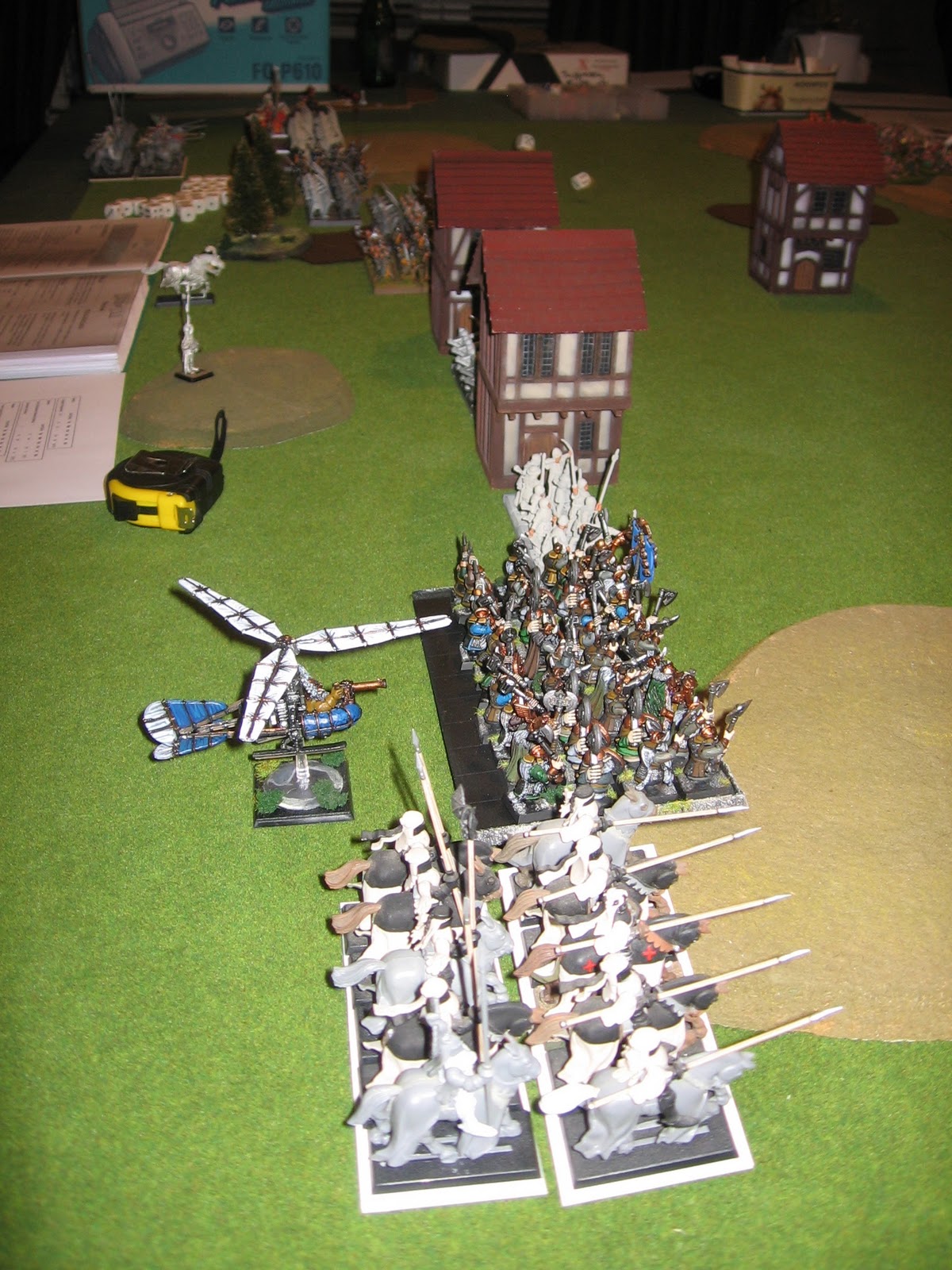
The Humans and Dwarfs had settled themselves on a largely defensive posture. Most of the line was composed of Footguard supported by archers. The right was held by a Dwarf horde supported by a steel behemoth. Knights sat on the flanks, awaiting the time to counterattack. It was all a matter of timing.
On they came ....
The men waited.
Orcs hit archers, there wasn't much resistance.
The Dwarves were determined to resist. The steel behemoth inched forward and blasted the orcs with it's breath weapon.
It was attacked by a winged kruger and a horde of orcs. They bounced off, after all it was a STEEL behemoth.
The main orc attack washed up along the centre and bounced.
Units counter attacked all along the line.
Orc units were smashed and shot away.
But still the onslaught continued.
The orcs made some gains, but as night fell both sides were exhausted. The orcs would withdraw to consider their next move, while the Kingdoms of Men licked their own wounds, and recruited once more to fill the empty ranks.
In game terms the conclusion came at the end of 12 turns (6 per side) with a draw. Considering the combat power of the orcs this was a reasonable result. The Kingdoms of Men had misused their knights, and so their counterattacks had been uncoordinated and lesss powerful than they could and should have been. But the infantry had stood their ground remarkably well.
For all that, a great game of Kings of War.
Monday, January 23, 2012
Thursday, January 19, 2012
Northern France 1944 - more 20mm Spearhead action.
Nick and I played another Spearhead game in 20mm today. This time I composed two forces of approximately 450 points per side, with the game set in northern France in late 1944. The game was an encounter game devised loosely around Keith McNelly's Scenario Generation System. Each side was of approximately regimental strength, with around half a regiment of armour and some off table artillery in support. The British were supported by 3 battalions of 25pdr guns, while the Germans had a regiment of 105mm howitzers in divisional support, and a regiment of 150mm guns dedicated to counter-battery support.
The first view is of the battle field at the start of the game, with the Germans entering from the left and the British from the right.
The British left flank battalion. The British armour can be seen behind in support.
This town sector was pivotal to the British left/German right. The Germans were first to occupy it with 3 platoons, with the reminder of the battalion and the armour and in support. Nick assaulted with two platoons. In an attack the likes of which I've never seen before he won the battle for the town, eliminating all three occupying platoons... extraordinary!!!
The German armour sat in support of the battalion holding their centre. The opposing British battalion took fire from the 105mm howitzers, the tank battalion and the infantry battalion. Despite the cover provided by the stone walls casualties mounted there and on their own left around the town.
Nick then changed orders for his armour and began a push around his left. The defending British infantry battalion then exceeded both 50% and 66% casualties in the one turn, and took two morale tests. It passed BOTH!! This British performance on their left was a day to remember.
The German armour began to push forward to take advantage of the flank that the British armour had presented as it attempted to attack the German right.
At the same time Nick now tried to apply pressure to the German centre by advancing. Nick was also by this stage beginning to make use of his artillery, concetrating fire from all three battalions. However as a consequence the German counter battery observer had been hard at work, and located all three battalions. Counter battery fire had begun, causing casualties on the British gunners.
I had decided to use my reserve battalion to try to take the bridge objective on the German left, and then to attack the open British right flank. However I miscalculated how long crossing the stream would take. This battalion took no part in the battle.
The game ended after 3 hours play, with the Germans scoring 5 victory points to the British 3, and of us having enjoyed a pretty good afternoon's game. Game play had been a little slower than you might expect as Nick learned the rules. The terrain had also hung up both sides, with both forces initially avoiding the stream, and so concentrating the deployment in a much smaller frontage than is usual.
All in all, a great game, and proof that SH will still work with 20mm figures and vehicles. My own plan was actually pretty mediocre, and I can easily imagine that with a few more games under his belt, Nick would have taken me apart quite convincingly. So, I may now need to base all of my old 20mm WW2 collections ready for some games.. sitting in those boxes is a HUGE pile of Russian kit... sigh!!
And here's Nick's version of events ...
The first view is of the battle field at the start of the game, with the Germans entering from the left and the British from the right.
The British left flank battalion. The British armour can be seen behind in support.
This town sector was pivotal to the British left/German right. The Germans were first to occupy it with 3 platoons, with the reminder of the battalion and the armour and in support. Nick assaulted with two platoons. In an attack the likes of which I've never seen before he won the battle for the town, eliminating all three occupying platoons... extraordinary!!!
The German armour sat in support of the battalion holding their centre. The opposing British battalion took fire from the 105mm howitzers, the tank battalion and the infantry battalion. Despite the cover provided by the stone walls casualties mounted there and on their own left around the town.
Nick then changed orders for his armour and began a push around his left. The defending British infantry battalion then exceeded both 50% and 66% casualties in the one turn, and took two morale tests. It passed BOTH!! This British performance on their left was a day to remember.
The German armour began to push forward to take advantage of the flank that the British armour had presented as it attempted to attack the German right.
At the same time Nick now tried to apply pressure to the German centre by advancing. Nick was also by this stage beginning to make use of his artillery, concetrating fire from all three battalions. However as a consequence the German counter battery observer had been hard at work, and located all three battalions. Counter battery fire had begun, causing casualties on the British gunners.
I had decided to use my reserve battalion to try to take the bridge objective on the German left, and then to attack the open British right flank. However I miscalculated how long crossing the stream would take. This battalion took no part in the battle.
The game ended after 3 hours play, with the Germans scoring 5 victory points to the British 3, and of us having enjoyed a pretty good afternoon's game. Game play had been a little slower than you might expect as Nick learned the rules. The terrain had also hung up both sides, with both forces initially avoiding the stream, and so concentrating the deployment in a much smaller frontage than is usual.
All in all, a great game, and proof that SH will still work with 20mm figures and vehicles. My own plan was actually pretty mediocre, and I can easily imagine that with a few more games under his belt, Nick would have taken me apart quite convincingly. So, I may now need to base all of my old 20mm WW2 collections ready for some games.. sitting in those boxes is a HUGE pile of Russian kit... sigh!!
And here's Nick's version of events ...
Wednesday, January 18, 2012
Eastern Front 1914 milestone
As a matter of record, today marked a cool milestone in the Eastern Front 1914 project: the first Russian infantry division is pretty much complete. Currently it has four regiments of 3 battalions which is arguably slightly later in the war (introduction began in 1915 if I have the correct), but it is now a viable game force. Ultimately the Scenario Generation System demands two divisions for Attack scenarios, but this single division is at least usable on the table for basic encounter games.
Completion of this first division was one of my summer painting goals. Now for a wee 'mini' project that has been percolating for a while, with the first figures on the painting desk ready to go. It fits with the Eastern Front 1914 theme.. stay watching!
Sunday, January 8, 2012
Italian wars of the 1860s
First outing last night for Adrian's new armies for the Wars of Italian Unification - Neopolitan Piedmontese, so just a few photos of the action.
The Neopolitans attack a town sector... they were summarily repulsed.. ouch.
Had to photograph this (for me this is a rarity..) - a Neopolitan M5 Shock unit went into the attack, four combat dice needing 5s or 6s to it... here's the roll.. made Adrian's eyes water, I can tell you.
That unit was then attacked by 3 units of Piedmontose cavalry. Fortunately they boys stood their ground and were just recoiled (it could have been much worse!!).
Lastly just a couple of shots of Adrian's units alongside some of his beautifully hand made Italian buildings.
The Neopolitans attack a town sector... they were summarily repulsed.. ouch.
Had to photograph this (for me this is a rarity..) - a Neopolitan M5 Shock unit went into the attack, four combat dice needing 5s or 6s to it... here's the roll.. made Adrian's eyes water, I can tell you.
That unit was then attacked by 3 units of Piedmontose cavalry. Fortunately they boys stood their ground and were just recoiled (it could have been much worse!!).
Lastly just a couple of shots of Adrian's units alongside some of his beautifully hand made Italian buildings.
Thursday, January 5, 2012
Russian enlistment ...
A brief update on the expansion of the 1914 Russian forces. Below are photos of the first two regiments which represent half of the fighting stands in a Great War Spearhead division.
This first regiment is painted as a 'conscript' regiment might have looked with old 1904 issue green and white clothing left over from 1904.
This second regiment is painted more 'conventionally' in the regulation 1914 'khaki green'. I have made a conscious effort to vary the shadings of the 'khaki' to represent the vagaries of massed production of dyes and uniforms, and the varying rates of fading of the fabrics. I achieve this by mixing small quantities of paint on the palette as I paint. I take a Vallejo British khaki brown, and blend in a little blue. The blue mixes with the yellow pigment in the khaki to give the greenish hue.
I also occasionally blend a little Citadel Kommando khaki to produce a more faded brown shade.
This first regiment is painted as a 'conscript' regiment might have looked with old 1904 issue green and white clothing left over from 1904.
This second regiment is painted more 'conventionally' in the regulation 1914 'khaki green'. I have made a conscious effort to vary the shadings of the 'khaki' to represent the vagaries of massed production of dyes and uniforms, and the varying rates of fading of the fabrics. I achieve this by mixing small quantities of paint on the palette as I paint. I take a Vallejo British khaki brown, and blend in a little blue. The blue mixes with the yellow pigment in the khaki to give the greenish hue.
I also occasionally blend a little Citadel Kommando khaki to produce a more faded brown shade.
Wednesday, January 4, 2012
New look WW2 Spearhead
I make no secret of the fact that the Spearhead stable of rules rank only slightly behind Volley and Bayonet as my all time favourite rules system. I play Great War Spearhead, WW2 and Modern Spearhead. When friend Nick G was around for a game recently he spotted the WW2 Spearhead rules set on the shelf and after a browse asked if we could try a game. Now I play WW2 SH in 6mm, while Nick odes his WW2 (mostly Crossfire I think) in 20mm. He asked if SH could work in 20mm. Now infantry are fine, but we did discuss the ground scale distortion that occurs with the larger 20mm vehicles. Despite this, we decided to give it a try. I set up a small 'training'; game with a battalion each of 1944 Germans and British. The Germans were supported by a small unit of 2 PzKwIIINs and the British battalion was supported by a 6pdr AT gun.
Nick took the Germans. The tanks advanced down a ridge line in the centre of the table and bumped straight into an infantry company. Further to the rear the 6pdr was sited in support. A combination of platoon AT fire and the 6pdr fire destroyed the tank platoon.. dashed good luck, but Nick had learned the first lesson... make sure infantry and armour support each other.
Nick's infantry advanced in a hook around the British left flank, although in responding to the armour threat I was able to re-orient the British defence to tackle the advancing Germans.
A bitter fight erupted as the two infantry battalions went 'head to head'.
Trying to take advantage of German suppression the British close assaulted a German platoon, thinking that there was no other platoon available to offer fire support. However Nick's HMG was able to bring fire to bear and stopped the British platoon in its tracks.
Bitter fighting ensued, but the Germans were winning the firefight, and it would soon all be over.
I am aware that others already play WW2 SH in 20mm, but for me it was something new, and it worked. This was a 'training' game for Nick with very small forces, and I still have my doubts about games with the more usual concentrations of vehicles where each side might include a battalion of armour, but it will be well worth trying. And I think Nick enjoyed it.. game on!!!
Nick took the Germans. The tanks advanced down a ridge line in the centre of the table and bumped straight into an infantry company. Further to the rear the 6pdr was sited in support. A combination of platoon AT fire and the 6pdr fire destroyed the tank platoon.. dashed good luck, but Nick had learned the first lesson... make sure infantry and armour support each other.
Nick's infantry advanced in a hook around the British left flank, although in responding to the armour threat I was able to re-orient the British defence to tackle the advancing Germans.
A bitter fight erupted as the two infantry battalions went 'head to head'.
Trying to take advantage of German suppression the British close assaulted a German platoon, thinking that there was no other platoon available to offer fire support. However Nick's HMG was able to bring fire to bear and stopped the British platoon in its tracks.
Bitter fighting ensued, but the Germans were winning the firefight, and it would soon all be over.
I am aware that others already play WW2 SH in 20mm, but for me it was something new, and it worked. This was a 'training' game for Nick with very small forces, and I still have my doubts about games with the more usual concentrations of vehicles where each side might include a battalion of armour, but it will be well worth trying. And I think Nick enjoyed it.. game on!!!
Wednesday, December 28, 2011
The Forgotten General
I
recently finished reading ‘The Forgotten General” (ISBN 978 1 877505 07 2),
Jock Vennell’s biography of Major General Sir Andrew Russell (Allen and Unwin,
2011).
I
first became aware of Russell’s extraordinary achievements when reading Glyn
Harper’s ‘Spring Offensive’, detailing the New Zealand Division’s part in the
Second Battle of the Somme in March 1918, and recall thinking at the time that
Russell must surely rank as one of the truly gifted generals of World War 1.
Indeed, Vennell joins Harper and Pugsley in saying so.
Russell
was born in New Zealand and sent to England for his education, at the end of
which he passed out from Sandhurst with the sword of honour for the best cadet
officer of his year in 1887. His professional career with the British army came
to an end when he left the army, bored with the frontier duties and attitudes
that he found. He commanded the NZ Brigade at Gallipoli and came out of the
campaign with a Knighthood, and command of the NZ Division that was then sent
to France. He commanded the Division right through to the end of the war,
turning down a Corp Command suggested by of both Haig and Godley, as his health
failed in the last few months of the war.
This
is the story of an extraordinary man who made (and admitted) his share of mistakes (the NZ Division’s
losses in their 12 October 1917 attack at Passchendaele would be his worst) but
who learned quickly. He valued the lives of his men, and combined tough
discipline with tactical innovation and thoroughness of preparation and
planning, to create one of the best performing divisions on the Western Front.
In
the Preface, Vennell writes:
“… prominent military historian Dr Chris Pugsley went much further, rating Russell as not only the outstanding divisional commander among the British armies that fought on the Western Front, but the one military commander of genius that New Zealand produced in the twentieth century.”
If
you are looking for an in depth analysis of Russell’s performances on the battlefield,
then you would be better advised to read Harper’s ‘Spring Offensive’, but for a
fascinating view of the life of New Zealand’s ‘Forgotten General’, you could do
little better than to read Vennell’s biography. I highly recommend the book to all 'students' of World war 1, and New Zealand military history.
Subscribe to:
Comments (Atom)
Spider Beast Packs.. another DBF game
Having last week played a game of DBF using the spiders as hordes, this week I played a smaller 80 poiont game against Andy, but this time t...
-
It's been quite a week of wargaming. Wednesday evening Murray and I completed the Great War Spearhead game in the alps . Wednesday saw u...
-
During the Great War the eastern and Italian fronts saw fierce fighting across rugged and mountainous terrain. Our preferred WW1 rules syste...
-
It's the Middle East theatre in 1915. British forces have been molested by the fire of a new Turkish armoured train providing support t...


