A dark ale and a lager, Nick's good company, and a couple of HotT armies - his Indians again, and my Lost Worlds.. shaping up to be a cracker evening. The armies deployed, both hoping that the Gods would favour them.
The Lost Worlds forces were seeking out treasure and sacrifices for their Ape God, and were hoping that they might find grist for the sacrificial altar in the Indian stronghold.
The Ape war bands forged forward, with the general mounted on his royal elephant in support. The forces of magic were also afoot, searing magic spells arcing across the sky, devastating bolts surging from finger tips.
The ape war bands hit the warrior lines, and the LW's right flank was under immediate pressure as their beasts were driven from the field.
However not to be outdone, the LW's behemoth T-Rex devoured the Indian beasts, and was still hungry for more.
Things became very confused in the centre as war band battled war band. Pterodactyls swooped into the Indian rear, trying to kill the Indians from their rear.
The T-Rex however had perhaps bitten off more than it could chew, and fell beneath the swiping claws and ravening jaws of yet more Indian beasts.
Finally the LWs incantations were answered, and the mighty Ape God appeared.
The Indian Hero finally made it to battle, tackling the threat to his war band's rear, and a Pterodactyl fell from the skies.
But the Ape God moved in to attack the Indian war bands from their rear, in support of the war band general who had been locked in battle for many turns.
Victory was theirs, and many would be the sacrifices to the Ape God this night.
Back on our own planet, Nick and I managed a second game in which he taught me a lesson or two, giving me a reasonably sound thrashing in return for this defeat. A great night's 'gaming.
Friday, August 13, 2010
Monday, August 9, 2010
New monkey war bands... and a quick Monday night game.
Nick has just finished a group of monkeys for his HotT armies.. a mix of warbands and hordes, for his semi historical Indian army and a delightful african animal army (... very cool concept). So he suggested we have a quick game with the Indians complete with monkey warbands. It seemed only right that the Victorian adventurers should front up the challenge.


The warbands were flanked by their beast supports as they moved into the rough terrain.
On the adventurers' flank their artillery took guard.
On their left the adventurers deployed shooters and their steam robot (behemoth).
The beasts headed towards the flanking artillery intent on doing some serious damage.
Two ones fell from Nick's hand, and both beast units were dead.... animal activists everywhere were up in arms!!
On his other flank Nick decided to go for it, with his hero general leading the charge into the adventurers' shooters and behemoth, supported by his loyal monkey warbands and his trusty magician.
There was lots of 'argy bargy', pushing and shoving!!
And then the Indian God appeared.... ooo darn!!!
A quick flanking attack on the behemoth....
A frontal attack on an artillery stand.. 'I'm a God, I don't give a damn!!'
... and the warbands finished the business, taking down more shooters..all over. The adventurers (well what was left of them) fled the jungles.
A great (and unexpected) mid week game.. and the monkeys look great!!!
Friday, August 6, 2010
Persians face off against Carthaginians...
Nick's birthday (where have those 28 years gone??), some pizza and red wine with the whole family, and... DBA.... Late Carthaginians vs Late Archaemenid Persians, both Book 2 Armies and ALMOST historical foes (but not quite). Both armies were painted by Nick, and are a mix of HaT and Caesar figures. DBA and a glass of Calvados, shaping up to be a good game.
A steep hill dominated the centre of the battlefield, and both sides pushed light troops forward to try to gain the advantage.
Meanwhile the Carthaginian 'panzer wedge', two elephants, pushed forward on the Carthaginian right.
A steep hill dominated the centre of the battlefield, and both sides pushed light troops forward to try to gain the advantage.
Meanwhile the Carthaginian 'panzer wedge', two elephants, pushed forward on the Carthaginian right.
The battle raged across the steep hill.
There were two bases if spear in the rough going, expecting to hold out against the Carthaginian mounted wing.
And they may have done so had it not been for several ones in a row from the Persian player... ouch!!
But the Persian light troops won the battle for the steep terrain, winning the bate for the Persians, even though the Carthaginian elephants were progressively pushing the Persian cavalry back.
Another great game, and one of the tightest I've played for quite a while. I managed to squeak the win, as much from a couple of badly timed poor die rolls from Nick.
Yep, another great evening. It's as much about the company as it is about the game.
Friday, July 30, 2010
And while I'm in a reminiscing mood..
I thought I should just promote this great blog 'Vintage wargaming' ...
... in case you haven't seen it yet.
It has brought back some great memories from the 'good old days'.. when you only had three packs of 20mm figures to choose from for ancients, and... as they say, the good old days often weren't, but ..
Well, they were still good old days.. but maybe for different reasons, maybe it's because I was younger????
Digital migrant in wargaming land.. the nostalgic smell of ink on paper
In the 90's I subscribed to the magazine "Practical Wargamer", and have quite a few copies in my 'games room.
I dragged them out the other night to hunt out some scenario ideas for the ACW. I had obviously already done that at some time in the past because I already have Volley and Bayonet conversions for all the scenarios I found. But the rather enjoyable and nostalgic browse set me thinking.
The war gaming magazines I have access to these days are so product specific! 'Practical Wargamer' used to cover a wide range of rules sets and periods, and I found a very cool scenario idea for an Austrian/Serbian game for 1914 (an unexpected benefit of the browse, although I now need to paint some Austrians.. ). But it is this very diversity that seems to be lacking from magazines today. Of course I suspect this is driven by an economic imperative, and shouldn't be taken as a criticism of the publishers of some very cool magazines on the market today. I buy 'White Dwarf', and enjoy reading it each month.
I guess I am just lamenting the loss of a delightful genre of magazine. I can get quite a lot of what I am after from the myriad of blogs and web sites that I follow, but I guess you can call me old fashioned - I love the smell of the ink on paper, the feel of the glossy magazine in my hands as I browse the pages in bed at night before I tackle the challenge of sleep. And these magazines had contributions from so many of those famous names, Charles Grant, Charles S Grant, Stuart Asquith. Ahh, those were the days. I'm certainly a digital migrant!!
I dragged them out the other night to hunt out some scenario ideas for the ACW. I had obviously already done that at some time in the past because I already have Volley and Bayonet conversions for all the scenarios I found. But the rather enjoyable and nostalgic browse set me thinking.
The war gaming magazines I have access to these days are so product specific! 'Practical Wargamer' used to cover a wide range of rules sets and periods, and I found a very cool scenario idea for an Austrian/Serbian game for 1914 (an unexpected benefit of the browse, although I now need to paint some Austrians.. ). But it is this very diversity that seems to be lacking from magazines today. Of course I suspect this is driven by an economic imperative, and shouldn't be taken as a criticism of the publishers of some very cool magazines on the market today. I buy 'White Dwarf', and enjoy reading it each month.
I guess I am just lamenting the loss of a delightful genre of magazine. I can get quite a lot of what I am after from the myriad of blogs and web sites that I follow, but I guess you can call me old fashioned - I love the smell of the ink on paper, the feel of the glossy magazine in my hands as I browse the pages in bed at night before I tackle the challenge of sleep. And these magazines had contributions from so many of those famous names, Charles Grant, Charles S Grant, Stuart Asquith. Ahh, those were the days. I'm certainly a digital migrant!!
Saturday, July 24, 2010
American Civil War 1862
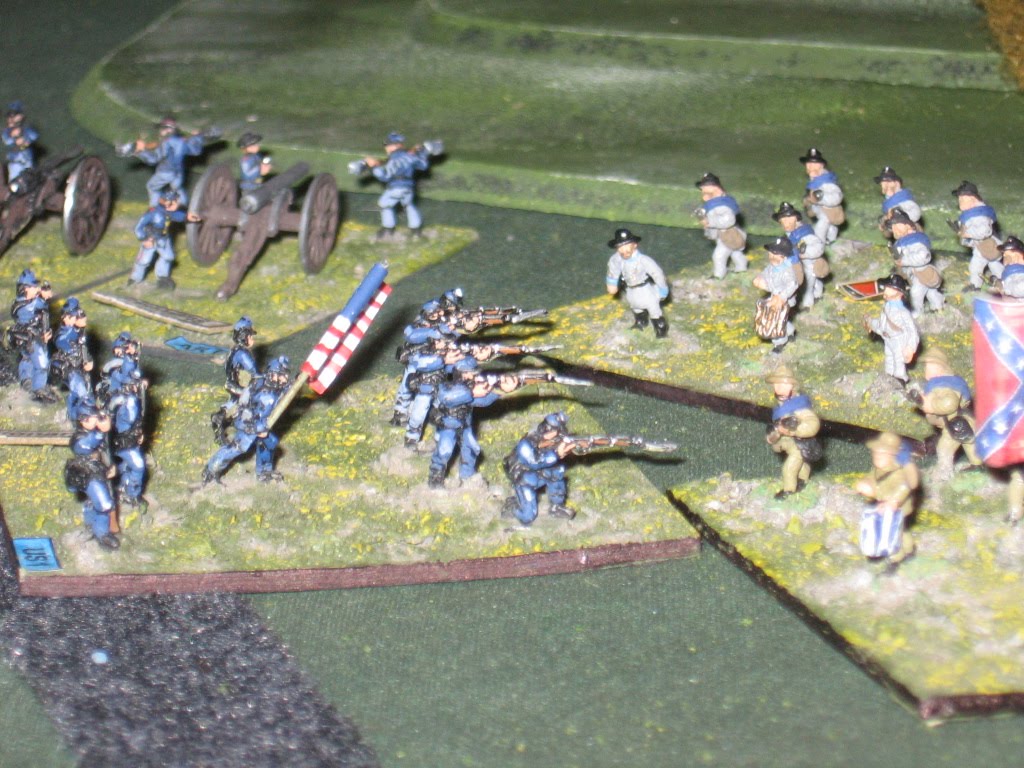
North America, June 1862, the Battle of Cross Keys, well a rough approximation anyway. We took a scenario from an old Miniature Wargames magazine, and converted it to Volley and Bayonet for our first American Civil War game in quite some time. It probably should have been fought at the lower Wing scale, but we opted to use the map and forces at normal VnB scale. The game was fought using my 15mm ACW forces (mostly FreiKorps figures). The buildings are scratch built from card.
The Union forces (largely M4 troops) are attacking a better quality Confederate force.
Confederate forces deployed in some of the many wooded areas of the battlefield.
The Confederate right/Union left, where so much of the action took place. The ravine that was so significant in the original battle is just behind the Confederate forces in the upper left of the photo.
The Union commander masse much of his artillery in his centre to try to blast the Confederate defenders out of their positions.
The Confederate right deteriorated in to a swirling melee with massed short range fire ringing out through the trees, and mad screaming as units charged and counter charged. The battle was eventually won by the Union attackers.
In the meantime the Confederate defenders boldly attacked through the centre. Here they are seen charging one of the defending Union brigades. However even here they were bloodily repulsed, and overall victory went to the Union forces.
We were in this case more interested in creating a good quality game than in recreating the original historical battle, and we succeeded. This was a close fought battle in which the balance swung several times. The Union forces snatched a final victory with a series of last turn charges that took advantage of a couple of very small battlefield advantages that had occurred on the Confederates' previous turn.
As always, a damned fine game.
One slightly contentious aspect of the second edition VnB rules for us is the zone of control. We decided to opt for a house rule where the ZOC only exists directly to the front of a stand (rather than extending to the sides as well), and to use the DBX WADBAG interpretation used in DBA games called the 'rolling carpet' interpretation. That is, The ZOC stops when it meets the first enemy unit. It works well in our opinion.
Wednesday, July 21, 2010
'Dark Journey' indeed..
I'm quite a fan of the work of NZ Historian Glyn Harper. I had bought and read his two books "Massacre at Passchendaele", and "Spring Offensive", but when 'Dark Journeys" was released I resisted, as it included these two books, plus what I simply understood as additional material. When I recently saw a copy on sale at a much reduced price I thought it might be worth buying a copy. I really should have read the Contents page more thoroughly when it first came out. The third part of the book is titled 'Bloody Bapaume', and what an eye opener it is.
Harper details what was in fact the bloodiest battle in which the NZ Division was involved on the Western Front, the taking of Bapaume in August 1918. His analysis is interesting, and not the least xenophobic. He details what he sees as the failings of the division at that time, not the least of which was the number of commanders who had been so recently promoted into their positions (in command of Brigades and Battalions) and so had little operational experience in their new positions, with units of these sizes. He also proposes that the Division came through as well as it did because Russell (operating at well below his own best at this stage, Harper suggests) had created what Harper calls a 'learning organisation' in which lessons were quickly learned, and in which men at all levels were willing to take control and resolve problems with which they were confronted without waiting for direction.
Haprer's analysis of casualties is interesting. He points out that Russell amongst others significantly understates the casualties that the division suffered in the battle, and is also able to show how badly the battle was reported in New Zealand, citing one newspaper that declared that Bapaume had fallen 2 days before it actually did.
I thoroughly recommend the book, even if purely for the account of 'Bloody Bapaume', and of course if you haven't purchased or read the earlier two books on Passchendaele and the Spring Offensive, then the book is an absolute gem. The book is published by Harper Collins, 2007.
Subscribe to:
Posts (Atom)
Somewhere in Greece 1941
I have long been a fan of Jeff Plowman's military history writing, and have a number of his books on my shelves. Once again just recentl...
-
The Battle for Lesnica in Serbia on 12 August 1914 was a small part of the larger action known as the Battle of Cer . This Great War Spearhe...
-
Much like elephants mating, wargames projects can be long in gestation. Murray began his 1914 Belgian division for Great War Spearhead quite...
-
My interest in gaming world war 2 in 20mm (with my fave Spearhead rules by Arty Conliffe, of course) has been rekindled after I gave Murray ...


