With a solid start made on the 1914 Russian forces for early eastern front battles, I've been looking somewhat longingly on a box of HaT Austro Hungarians that some kind soul had given me several years ago. So, without further ado I've made a start. The box will give me a Great War Spearhead regiment, as long as I buy a box of HaT AH heavy weapons to go with them. They should complement the 1914 Germans quite nicely.
My usual painting style didn't quite work with the AH Hechtgrau I thought (I mixed it manually, by the way), so I decided to chance an arm and try block painting with ink washes and dry brushes. Here is the result on the first 6 stands. The jury is still out to some degree.. maybe with practice I can get a better result.
Tuesday, February 7, 2012
Sunday, January 29, 2012
Origins of our fantasy games.
Even though I wargame the fantasy genre
using the HotT (Hordes of the Things) wargames rules (and more recently the 'Kings of war' rules from Mantic), I haven’t traditionally
been a reader of fantasy literature. As a university student I was a voracious
reader of the sci-fi genre, but that was quite some years ago. My reading of
the fantasy genre has really only included Tolkein, a little of John Norman’s “Gor”
series (only a couple of books actually), and I guess that Frank Herbert’s Dune
series came close as well.
Recently I discovered the writing of Helen Lowe. Helen describes herself on her blog as “a novelist, poet, interviewer and lover of
story”. She lives in Christchurch, and has previously written books for a
younger audience including ‘Thornspell’. In 2010 her first fantasy
novel for an adult audience (‘The Heir of Night” Orbit Books, ISBN 978-0-356-50008-9) was published. Having
followed Helen’s Blog (and taken some of her advice for aspirant writers) for
some time I decided that I should read some of her work. It took a little while
to track down a copy of ‘The Heir of Night’ (bookstores in post quake
Christchurch are scarce, to say the least), but I finally found the book
stocked in a great bookstore in Wellington.
I found myself transfixed by ‘The Heir of
Night’. Helen has created a fantasy world vaguely resembling (as many of them
do) something slightly medieval, but a world that is wholly absorbing. Helen’s
skill at creating such a world, her skill at story telling in fact, deserves to
be compared not only with writers like Frank Herbert, but could in my opinion
equally hold its own with writers of the stature of Tolkien. Her writing is
lyrical where it should be, fast paced where it should be, and demanding of the
reader’s concentration where it should be. In short, it is a damned good read.
I could hardly put the book down. It is little wonder that the book has been
nominated for two Gemmell Awards in London this year.
Even if you only vaguely thought that you
might just possibly consider maybe reading something sort of akin to fantasy,
READ THIS!!
The second part of the story ‘The Gathering
of the Lost’ is due out in early April 2012. I’ll be looking out for it.
Monday, January 23, 2012
Orc advance halted ...
Kings of War time again, and this time a largely Human force (Kingdoms of Men), with just a few Dwarf reinforcements, stood before the Orc hordes. The Orcs were keen to get forward and in to contact.
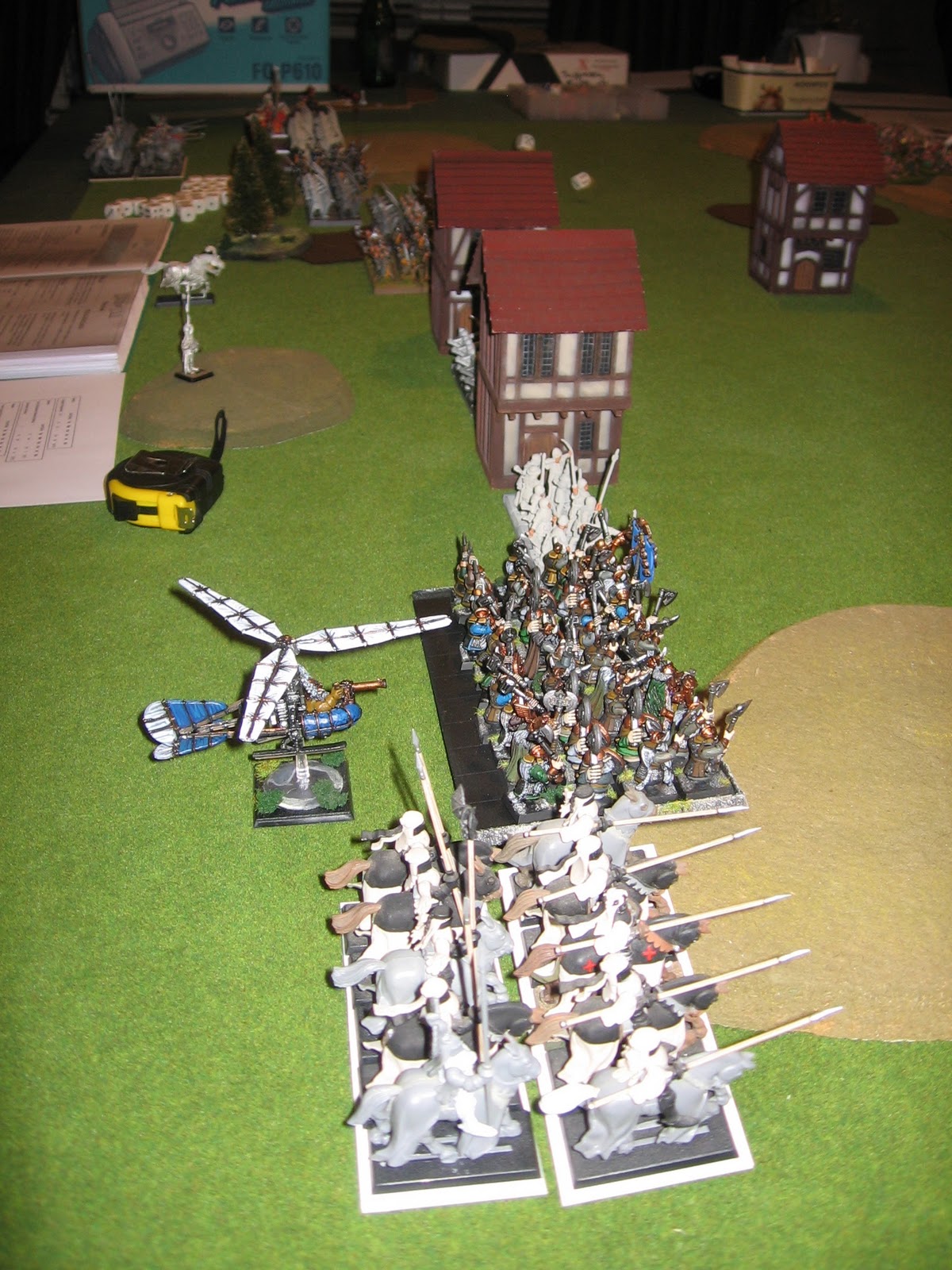
The Humans and Dwarfs had settled themselves on a largely defensive posture. Most of the line was composed of Footguard supported by archers. The right was held by a Dwarf horde supported by a steel behemoth. Knights sat on the flanks, awaiting the time to counterattack. It was all a matter of timing.
On they came ....
The men waited.
Orcs hit archers, there wasn't much resistance.
The Dwarves were determined to resist. The steel behemoth inched forward and blasted the orcs with it's breath weapon.
It was attacked by a winged kruger and a horde of orcs. They bounced off, after all it was a STEEL behemoth.
The main orc attack washed up along the centre and bounced.
Units counter attacked all along the line.
Orc units were smashed and shot away.
But still the onslaught continued.
The orcs made some gains, but as night fell both sides were exhausted. The orcs would withdraw to consider their next move, while the Kingdoms of Men licked their own wounds, and recruited once more to fill the empty ranks.
In game terms the conclusion came at the end of 12 turns (6 per side) with a draw. Considering the combat power of the orcs this was a reasonable result. The Kingdoms of Men had misused their knights, and so their counterattacks had been uncoordinated and lesss powerful than they could and should have been. But the infantry had stood their ground remarkably well.
For all that, a great game of Kings of War.
The Humans and Dwarfs had settled themselves on a largely defensive posture. Most of the line was composed of Footguard supported by archers. The right was held by a Dwarf horde supported by a steel behemoth. Knights sat on the flanks, awaiting the time to counterattack. It was all a matter of timing.
On they came ....
The men waited.
Orcs hit archers, there wasn't much resistance.
The Dwarves were determined to resist. The steel behemoth inched forward and blasted the orcs with it's breath weapon.
It was attacked by a winged kruger and a horde of orcs. They bounced off, after all it was a STEEL behemoth.
The main orc attack washed up along the centre and bounced.
Units counter attacked all along the line.
Orc units were smashed and shot away.
But still the onslaught continued.
The orcs made some gains, but as night fell both sides were exhausted. The orcs would withdraw to consider their next move, while the Kingdoms of Men licked their own wounds, and recruited once more to fill the empty ranks.
In game terms the conclusion came at the end of 12 turns (6 per side) with a draw. Considering the combat power of the orcs this was a reasonable result. The Kingdoms of Men had misused their knights, and so their counterattacks had been uncoordinated and lesss powerful than they could and should have been. But the infantry had stood their ground remarkably well.
For all that, a great game of Kings of War.
Thursday, January 19, 2012
Northern France 1944 - more 20mm Spearhead action.
Nick and I played another Spearhead game in 20mm today. This time I composed two forces of approximately 450 points per side, with the game set in northern France in late 1944. The game was an encounter game devised loosely around Keith McNelly's Scenario Generation System. Each side was of approximately regimental strength, with around half a regiment of armour and some off table artillery in support. The British were supported by 3 battalions of 25pdr guns, while the Germans had a regiment of 105mm howitzers in divisional support, and a regiment of 150mm guns dedicated to counter-battery support.
The first view is of the battle field at the start of the game, with the Germans entering from the left and the British from the right.
The British left flank battalion. The British armour can be seen behind in support.
This town sector was pivotal to the British left/German right. The Germans were first to occupy it with 3 platoons, with the reminder of the battalion and the armour and in support. Nick assaulted with two platoons. In an attack the likes of which I've never seen before he won the battle for the town, eliminating all three occupying platoons... extraordinary!!!
The German armour sat in support of the battalion holding their centre. The opposing British battalion took fire from the 105mm howitzers, the tank battalion and the infantry battalion. Despite the cover provided by the stone walls casualties mounted there and on their own left around the town.
Nick then changed orders for his armour and began a push around his left. The defending British infantry battalion then exceeded both 50% and 66% casualties in the one turn, and took two morale tests. It passed BOTH!! This British performance on their left was a day to remember.
The German armour began to push forward to take advantage of the flank that the British armour had presented as it attempted to attack the German right.
At the same time Nick now tried to apply pressure to the German centre by advancing. Nick was also by this stage beginning to make use of his artillery, concetrating fire from all three battalions. However as a consequence the German counter battery observer had been hard at work, and located all three battalions. Counter battery fire had begun, causing casualties on the British gunners.
I had decided to use my reserve battalion to try to take the bridge objective on the German left, and then to attack the open British right flank. However I miscalculated how long crossing the stream would take. This battalion took no part in the battle.
The game ended after 3 hours play, with the Germans scoring 5 victory points to the British 3, and of us having enjoyed a pretty good afternoon's game. Game play had been a little slower than you might expect as Nick learned the rules. The terrain had also hung up both sides, with both forces initially avoiding the stream, and so concentrating the deployment in a much smaller frontage than is usual.
All in all, a great game, and proof that SH will still work with 20mm figures and vehicles. My own plan was actually pretty mediocre, and I can easily imagine that with a few more games under his belt, Nick would have taken me apart quite convincingly. So, I may now need to base all of my old 20mm WW2 collections ready for some games.. sitting in those boxes is a HUGE pile of Russian kit... sigh!!
And here's Nick's version of events ...
The first view is of the battle field at the start of the game, with the Germans entering from the left and the British from the right.
The British left flank battalion. The British armour can be seen behind in support.
This town sector was pivotal to the British left/German right. The Germans were first to occupy it with 3 platoons, with the reminder of the battalion and the armour and in support. Nick assaulted with two platoons. In an attack the likes of which I've never seen before he won the battle for the town, eliminating all three occupying platoons... extraordinary!!!
The German armour sat in support of the battalion holding their centre. The opposing British battalion took fire from the 105mm howitzers, the tank battalion and the infantry battalion. Despite the cover provided by the stone walls casualties mounted there and on their own left around the town.
Nick then changed orders for his armour and began a push around his left. The defending British infantry battalion then exceeded both 50% and 66% casualties in the one turn, and took two morale tests. It passed BOTH!! This British performance on their left was a day to remember.
The German armour began to push forward to take advantage of the flank that the British armour had presented as it attempted to attack the German right.
At the same time Nick now tried to apply pressure to the German centre by advancing. Nick was also by this stage beginning to make use of his artillery, concetrating fire from all three battalions. However as a consequence the German counter battery observer had been hard at work, and located all three battalions. Counter battery fire had begun, causing casualties on the British gunners.
I had decided to use my reserve battalion to try to take the bridge objective on the German left, and then to attack the open British right flank. However I miscalculated how long crossing the stream would take. This battalion took no part in the battle.
The game ended after 3 hours play, with the Germans scoring 5 victory points to the British 3, and of us having enjoyed a pretty good afternoon's game. Game play had been a little slower than you might expect as Nick learned the rules. The terrain had also hung up both sides, with both forces initially avoiding the stream, and so concentrating the deployment in a much smaller frontage than is usual.
All in all, a great game, and proof that SH will still work with 20mm figures and vehicles. My own plan was actually pretty mediocre, and I can easily imagine that with a few more games under his belt, Nick would have taken me apart quite convincingly. So, I may now need to base all of my old 20mm WW2 collections ready for some games.. sitting in those boxes is a HUGE pile of Russian kit... sigh!!
And here's Nick's version of events ...
Wednesday, January 18, 2012
Eastern Front 1914 milestone
As a matter of record, today marked a cool milestone in the Eastern Front 1914 project: the first Russian infantry division is pretty much complete. Currently it has four regiments of 3 battalions which is arguably slightly later in the war (introduction began in 1915 if I have the correct), but it is now a viable game force. Ultimately the Scenario Generation System demands two divisions for Attack scenarios, but this single division is at least usable on the table for basic encounter games.
Completion of this first division was one of my summer painting goals. Now for a wee 'mini' project that has been percolating for a while, with the first figures on the painting desk ready to go. It fits with the Eastern Front 1914 theme.. stay watching!
Sunday, January 8, 2012
Italian wars of the 1860s
First outing last night for Adrian's new armies for the Wars of Italian Unification - Neopolitan Piedmontese, so just a few photos of the action.
The Neopolitans attack a town sector... they were summarily repulsed.. ouch.
Had to photograph this (for me this is a rarity..) - a Neopolitan M5 Shock unit went into the attack, four combat dice needing 5s or 6s to it... here's the roll.. made Adrian's eyes water, I can tell you.
That unit was then attacked by 3 units of Piedmontose cavalry. Fortunately they boys stood their ground and were just recoiled (it could have been much worse!!).
Lastly just a couple of shots of Adrian's units alongside some of his beautifully hand made Italian buildings.
The Neopolitans attack a town sector... they were summarily repulsed.. ouch.
Had to photograph this (for me this is a rarity..) - a Neopolitan M5 Shock unit went into the attack, four combat dice needing 5s or 6s to it... here's the roll.. made Adrian's eyes water, I can tell you.
That unit was then attacked by 3 units of Piedmontose cavalry. Fortunately they boys stood their ground and were just recoiled (it could have been much worse!!).
Lastly just a couple of shots of Adrian's units alongside some of his beautifully hand made Italian buildings.
Thursday, January 5, 2012
Russian enlistment ...
A brief update on the expansion of the 1914 Russian forces. Below are photos of the first two regiments which represent half of the fighting stands in a Great War Spearhead division.
This first regiment is painted as a 'conscript' regiment might have looked with old 1904 issue green and white clothing left over from 1904.
This second regiment is painted more 'conventionally' in the regulation 1914 'khaki green'. I have made a conscious effort to vary the shadings of the 'khaki' to represent the vagaries of massed production of dyes and uniforms, and the varying rates of fading of the fabrics. I achieve this by mixing small quantities of paint on the palette as I paint. I take a Vallejo British khaki brown, and blend in a little blue. The blue mixes with the yellow pigment in the khaki to give the greenish hue.
I also occasionally blend a little Citadel Kommando khaki to produce a more faded brown shade.
This first regiment is painted as a 'conscript' regiment might have looked with old 1904 issue green and white clothing left over from 1904.
This second regiment is painted more 'conventionally' in the regulation 1914 'khaki green'. I have made a conscious effort to vary the shadings of the 'khaki' to represent the vagaries of massed production of dyes and uniforms, and the varying rates of fading of the fabrics. I achieve this by mixing small quantities of paint on the palette as I paint. I take a Vallejo British khaki brown, and blend in a little blue. The blue mixes with the yellow pigment in the khaki to give the greenish hue.
I also occasionally blend a little Citadel Kommando khaki to produce a more faded brown shade.
Subscribe to:
Posts (Atom)
Attack into Belgium 1914
Much like elephants mating, wargames projects can be long in gestation. Murray began his 1914 Belgian division for Great War Spearhead quite...
-
I can still recall seeing the photos and reviews of those Greenwood and Ball Napoleonics, and early Peter Laing 15mm figures for the Marlbur...
-
What is the measure of a good set of wargames rules? Ask 100 'gamers and you'll likely get 100 different answers, although I suspect...
-
The Battle for Lesnica in Serbia on 12 August 1914 was a small part of the larger action known as the Battle of Cer . This Great War Spearhe...